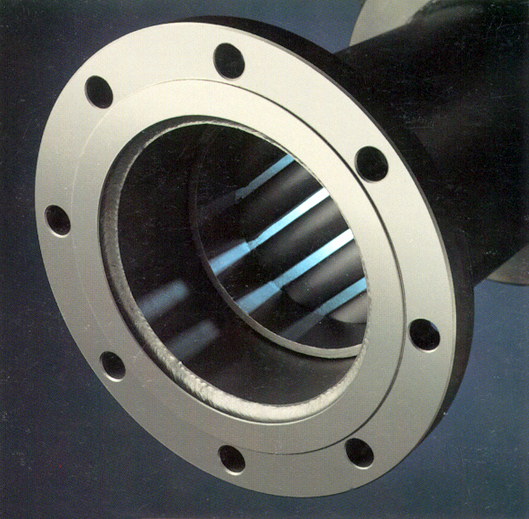
Looking into the bore of an ID series unit. High-powered permanent magnets and venturi tubes in a 304 stainless steel body, ASA flanged. The water goes through the unit, not past it.
Powered by physics. Not chemistry.
Built on magnetic field work John Meckling first patented in 1974.
Supplied to Inland Steel, National Steel, General Motors, Ford, NASA and the U.S. Coast Guard. Over 16,000 units installed in Japan and Korea alone.
Looking into the bore of an ID series unit. High-powered permanent magnets and venturi tubes in a 304 stainless steel body, ASA flanged. The water goes through the unit, not past it.
Published studies and field records are on the evidence page, with primary sources linked.
Before it could keep buying, the Texas Department of Criminal Justice was required by its procurement rules to look for an alternative supplier. That search ran ten months. It recommended sole-source purchase instead.
"There is no equal available at this time to the Magnetohydrodynamics Unit as manufactured by the Hydrodynamics Corporation (former name) ... we are recommending that State Purchasing use this vendor as its sole source."
Jim Buffington, Plant Maintenance Manager II, Design/Engineering, Texas Department of Criminal Justice
Scale is an insulating layer on heat transfer surfaces. It drives up fuel consumption, shortens equipment life and can eventually close the pipes. The conventional answer is chemical treatment. That approach has three structural weaknesses.
Scale inhibitors only work while they are being dosed at the right concentration. A pump failure, a late delivery, a tank that runs dry over a weekend, and scale deposition starts again.
Inhibitors are designed to stop scale forming but won't clear existing scale. The standard chemical remedy is a shutdown and an acid wash: lost production, a hazardous waste stream, and acid that attacks the metal along with the scale deposits.
Chemicals are consumed, so the spend never stops. Blowdown flushes them out of the system, which means buying them again to replace what went down the drain, and paying disposal fees.
It's plumbed into the line permanently. No power, no dosing. No consumable elements, no moving parts, no scheduled service. It allows a cooling tower to run at much higher cycles of concentration. It replaces scale chemicals only: corrosion inhibitors and biocides are a separate matter, and stay. Lifespan? A unit inspected after 25 years in service had lost only 5% of its field strength.
Fit it and forget it.
The most efficient system is the one that never stops working.
One technology. Multiple industrial and commercial applications. Sized to your flow rate.
Prevent nozzle clogging and reservoir scale in commercial building humidification systems.
Active in Class A Toronto buildingsPrevent and remove scale buildup without chemicals, increase cycles of concentration and reduce water consumption.
Cut scale inhibitors, acid washes and softener salt. Reduce fuel costs and extend equipment life.
14-year proven reference availableZero upfront cost. We install. You measure. We share the verified savings.
Our team installs the stainless steel MHD unit on your system at zero cost to you. No power, no chemicals, no bypass needed.
We establish your baseline chemical and fuel costs. After the trial, we verify the results together using your actual invoices.
You keep the majority of the savings. We keep a percentage as our compensation. If we don't hit the target, you pay nothing.
Amoco’s Director of Environmental Technology and an Amoco engineer ran a three-phase trial on progressively larger systems, and published the results. They tested MHD units on refinery cooling water from the Brazos River.
Fear of scaling had held cycles of concentration below two, which meant huge blowdown volumes, constant makeup water, and treatment chemicals going down the drain. Under MHD tests the same water ran above 35 cycles with the exchangers opening clean and scale-free.
A maintenance shop cooling tower with a history of serious scaling. pH control stopped, blowdown shut off, salts allowed to concentrate past 35 cycles. The exchanger was opened and inspected: no scaling found. On stream over two years at the time of writing.
A larger system, run essentially unattended at 40 to 50 cycles. Opened after four months in the scaling mode: tubes all clean and bright, no evidence of scaling anywhere. Ten months total with no maintenance and no heat loss.
Two 36-inch units on a large reformer’s cooling circuit from July 1983. The unit normally developed severe heat transfer problems within weeks of startup. After 15 weeks in the scaling mode there was no loss of heat transfer in the exchangers monitored.
The paper’s cost curve puts annual cooling tower water costs (makeup, blowdown, corrosion chemicals, effluent and treatment charges) at roughly $550,000 at 1.75 cycles of concentration, falling to about $50,000 at 15 cycles. Those are 1984 dollars, and the curve is a model of costs against cycles rather than a measured invoice. At CPI the same gap is on the order of $1.5 million a year today.
Magnet arrays in a spool piece, opposite poles focused across a venturi slot, about 4 psi pressure drop. The paper concludes that two focused fields of about 1,700 gauss with water passing at 6 m/s or faster gave adequate scale control. When strainer blockage dropped velocity, scaling began, then stopped once flow was restored.
Grutsch & McClintock, Corrosion and Deposit Control in Alkaline Cooling Water Using Magnetic Water Treatment at Amoco’s Largest Refinery, NACE Corrosion/84, paper 330. Corrosion control ran on a separate chromate program throughout; the MHD units controlled scale. The paper does not name the equipment manufacturer. John Meckling’s correspondence of 2001 describes units at Amoco’s largest refinery. We state both records and leave the connection to the reader. See the full evidence page →
Magnetic water treatment has a mixed reputation. We keep a separate page setting out how the units work, what the published record says, and what the studies that found nothing actually tested. The primary sources are linked, including the ones that went against the technology.
Selected references from industrial, commercial, institutional, and utility installations.
"Identical tests using treated and non-treated water clearly show that the Hydrodynamics [former company name] "MHD" Water Scale Control System can control and inhibit scale from forming in a Geothermal environment. The equipment used in this application will operate longer and more efficiently by using a Hydrodynamics System for treating the water".
Report on tests at the US DOE Geothermal Test Facility East Mesa, California
"Almost 14 years and we have not had to acid wash our boilers in all that time as well as eliminating the use of all chemicals. We specify the installation of your water treatment equipment in all of our new buildings."
Robert Geltman Geltman & Co. Properties, New York City
"The entire domestic hot water system of the hospital is as clean as this tube bundle (photo attached) eliminating entirely the usual problems of restricting flow and loose particles of calcium buildup in the piping."
Lynn J. Cucullu Administrative Director, East Jefferson General Hospital
"After four weeks the scale became soft and porous. After five weeks the scale no longer adhered to the heat exchanger plates. The transfer lines to the mud mix box and the bleach plant were cleaning up."
Hong Kong & China Gas Heat exchanger installation
"We installed an MHD unit on our boiler, which is fuelled by rice husk, and started feeding raw water. We also stopped feeding chemicals. We observed during [the] trial period that the scale was removing rapidly in the form of heavy precipitates... When we opened the boiler we saw that the boiler was very much cleaned and there was a very thin layer of soft powdery scale which was easily washed through pressure of water. From above experience we concluded that this device is very useful for removal of scale as well as prevention of new scale forming".
Madni Dyeing and Printing Mills Gujranwala, Pakistan
Fifty years of industrial water treatment systems in 42 countries.
John Meckling files the application that becomes US patent 4,023,057: laminated compound magnets using metal spacers to collapse the fields of the layers, raise flux density at the poles and establish focused field paths. He had come to magnet design from magnetohydrodynamic propulsion work at Brunswick and Martin Marietta, and held further magnet patents in 1975 and 1976.
The inline MHD scale control unit reaches market under the Hydrodynamics Corporation name, from Bogalusa, Louisiana. The Louisiana trademark record dates first commercial use to 15 September 1975.
Meckling begins exporting. Eventually the technology reaches 42 countries, with a Japanese Diet member actively promoting the product. Sales later peak at $12 million with 300 representatives worldwide.
Awarded GSA Contract #GS-07F-3786A by the U.S. General Services Administration, making MHD a pre-approved federal vendor.
E.B. Eddy Forest Products in Espanola, Ontario installs MHD on lime kiln slurry lines, eliminating $75,000 a year in cleaning costs.
Hydrodynamics Corporation becomes Meckling MHD Systems, which is why earlier test reports carry the Hydrodynamics name.
Roundtree & Associates, a top-10 Mississippi oil producer, becomes a repeat customer and later attempts to partner with Meckling to expand manufacturing.
Geltman & Co. Properties in New York City reports 14 years of zero acid washes and zero chemicals. They specify MHD in every new building.
Following John Meckling's passing, the business is acquired and moves to Toronto. It has been Canadian-owned since.
Heavy industrial inline MHD units. 304 stainless steel. NPT or flanged connections.
Sized by flow rate, not pipe diameter.
For heavy industrial applications: refineries, power plants, sugar mills, mining, marine, and municipal water systems. Standard 150 lb. ASA flanges. Optional 300 lb. and 600 lb. flanges available.
| Model | Pipe Size | Flow Rate (GPM) | Best For |
|---|---|---|---|
| ID-15 | 1.5" | 25 | Small industrial boilers, process lines |
| ID-20 | 2" | 50 | Mid-size boilers, chemical processing |
| ID-25 | 2.5" | 75 | Industrial heat exchangers |
| ID-30 | 3" | 100 | Process water, food & beverage |
| ID-40 | 4" | 200 | Large boilers, condensers |
| ID-50 | 5" | 300 | Refineries, pulp & paper |
| ID-60 | 6" | 450 | Evaporators, large cooling systems |
| ID-80 | 8" | 800 | Power plants, sugar mills |
| ID-100 | 10" | 1,200 | Heavy industrial cooling loops |
| ID-120 | 12" | 1,700 | Mining, desalination |
| ID-140 | 14" | 2,350 | Large-scale municipal water |
| ID-160 | 16" | 3,000 | Major refineries, petrochemical |
| ID-180 | 18" | 3,800 | District cooling, utility-scale |
| ID-200 | 20" | 4,800 | Large municipal, power generation |
| ID-240 | 24" | 6,900 | Major industrial infrastructure |
| ID-300 | 30" | 10,800 | Utility-scale water systems |
| ID-360 | 36" | 15,500 | Large-scale power, desalination |
| ID-420 | 42" | 21,100 | Major pipeline infrastructure |
| ID-480 | 48" | 27,600 | Heavy utility, marine |
| ID-540 | 54" | 34,900 | Large marine, industrial plants |
| ID-600 | 60" | 43,200 | Maximum capacity installations |
For commercial HVAC, small boilers, humidifiers, irrigation, and laundry systems.
| Model | Pipe Size | Flow Rate (GPM) | Best For |
|---|---|---|---|
| LC-3 | 3/4" | 3 | Small humidifiers, light commercial |
| LC-6 | 1" | 6 | Humidifiers, residential commercial |
| LC-12 | 1.5" | 12 | Small boilers, commercial HVAC |
| LC-18 | 2" | 18 | Mid-size boilers, irrigation pump stations |
| LC-27 | 2" | 27 | Boilers, golf irrigation, commercial laundry |
| LC-50 | 3" | 50 | Large boilers, cooling towers |
| LC-75 | 4" | 75 | Industrial cooling, district heating |
| LC-100 | 4" | 100 | Power generation, heavy industry |
| LC-150 | 6" | 150 | Refineries, large-scale irrigation |
| LC-200 | 6" | 200 | Municipal, sugar mills, major utilities |
We install an MHD unit on your boiler, humidifier or cooling tower at zero upfront cost. You measure chemical usage and energy consumption before and after. If verified savings do not meet projections, we remove the unit and you pay nothing.
Tell us about your application. We will recommend the right unit.